Museums
The data definitions within museums are divided into three sub-areas:
- Collection
- Events and Relations
- Sales
In addition, it builds on generic heritage data definitions to enable data exchange. The museum data model uses the generic heritage object types.
Collection
Within the Collection, the objects that belong to the museum are central. These are called Museum Object. Museum objects have a Location and may be on loan; in that case they have a Loan object attached. A loan links to a Lender, who may be the Museum Prinsenhof itself (lending out) or an external lender (borrowing from). Lenders are a Legal Entity: natural or non-natural person. Museum objects may also have a Stakeholder with a particular role relative to the object.
In addition to the collection, exhibitions are administered, with linked rooms used and exhibition curators. Each exhibition tracks which museum objects are part of it.
Historical persons are also administered, and their relation to museum objects via Role. Incidents are administered and linked to the museum objects.
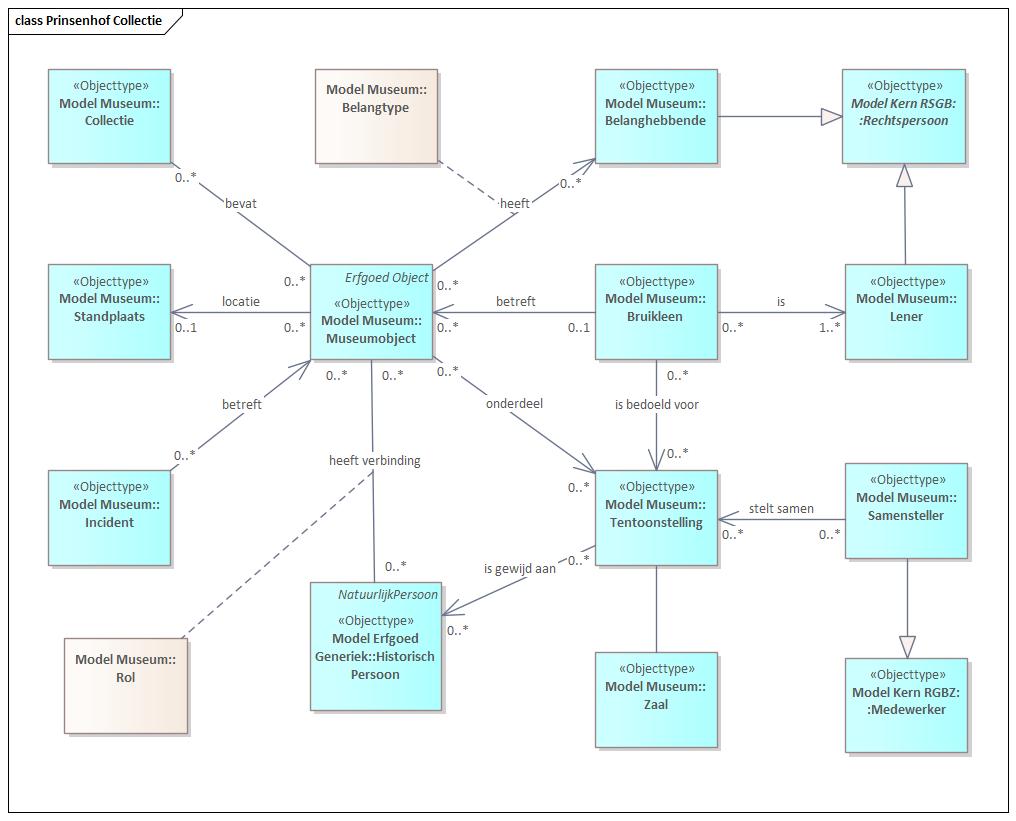
Diagram (in Dutch): data model for the museum Collection — museum objects, locations, loans, exhibitions, historical persons and incidents.
Events and Relations
Here, activities within programmes for museum contacts are central. A Programme consists of 0 or more activities. Each Activity may consist of 0 or more sub-activities. An Activity is of an Activity type. The same goes for a programme (of a Programme type). Reservations may be linked to an Activity — for rooms, facilities and production units. This is represented by a link from Reservation to 0 or more Room, Production unit and Facility objects. A Production unit may be an external supplier, in which case there is a link to Supplier. An Activity may have a Guided Tour attached, which may link to an Exhibition.
A Programme has a cost centre linking it to a Cost Centre, securing the link with financial administration.
Within the Prinsenhof data model, relations (persons, businesses, institutions) are modelled as Museum Relation. A Museum Relation is derived from Legal Entity, retaining all required characteristics such as name, address and Chamber-of-Commerce number. Mailings are sent to museum relations, so the Mailing object type is linked to Museum Relation.
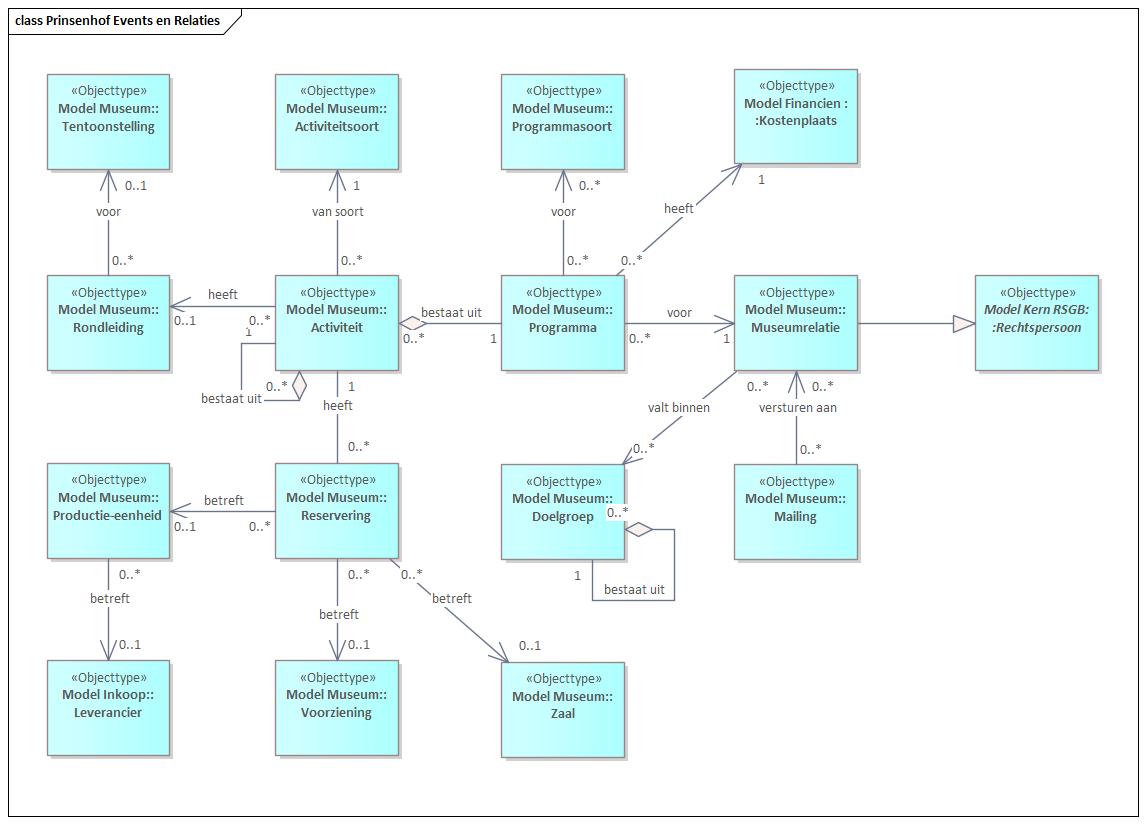
Diagram (in Dutch): data model for Museum Events and Relations.
Retail sales
In the sales data model, the Product to be sold is central. An Entry Ticket is derived from product and is modelled as something that can be sold alongside other products. All products have 0 or more product groups and revenue groups. A Product may have a Supplier and a Stock Item recording stock levels. Products may have multiple Counter Sales, recording how many and when a given product was sold. A Counter Sale Entry Ticket is a derivative of Counter Sale and allows capturing ticket-specific information such as start time and validity duration.
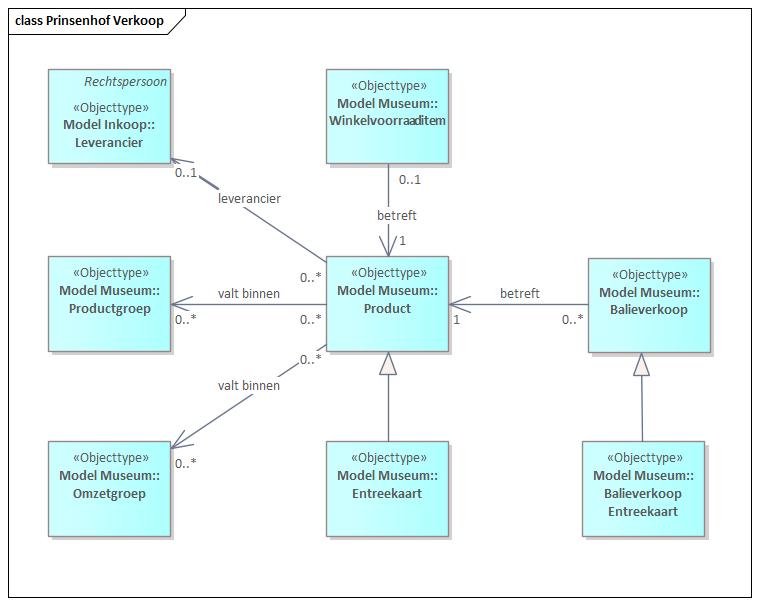
Diagram (in Dutch): data model for the Museum retail shop — products, sales, stock and tickets.