Economy
The data definitions for Economy concentrate on company Branches (establishments). They have a location in the city and largely determine how the local economy is perceived.
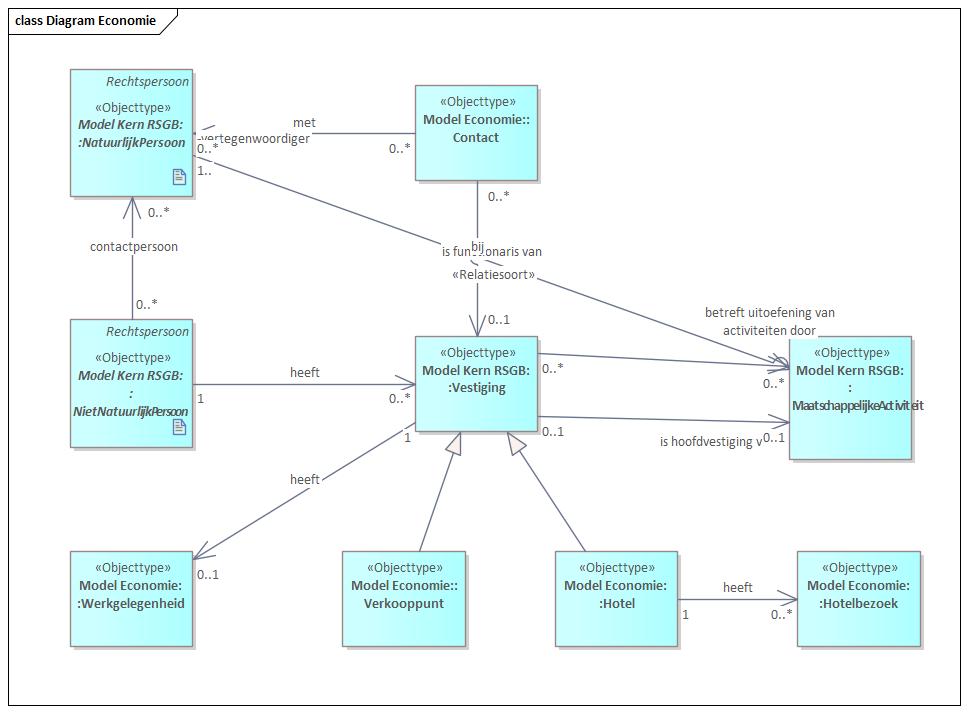
Diagram (in Dutch): the data model for Economy and business activity.
Central is Branch, which can have a specialisation as Sales Outlet (shop) or Hotel. For more types of company no specific information is tracked here (generic information is). A Hotel can have Hotel Visits (overnight stays). A Branch performs a Social Activity (top relation) and may have a head branch via the Social Activity.
Per Branch, Employment can be tracked, such as the number of male and female employees.
A Branch is connected to a Non-Natural Person — the company (or other legal entity) the Branch belongs to. Contact Persons are administered for the company.
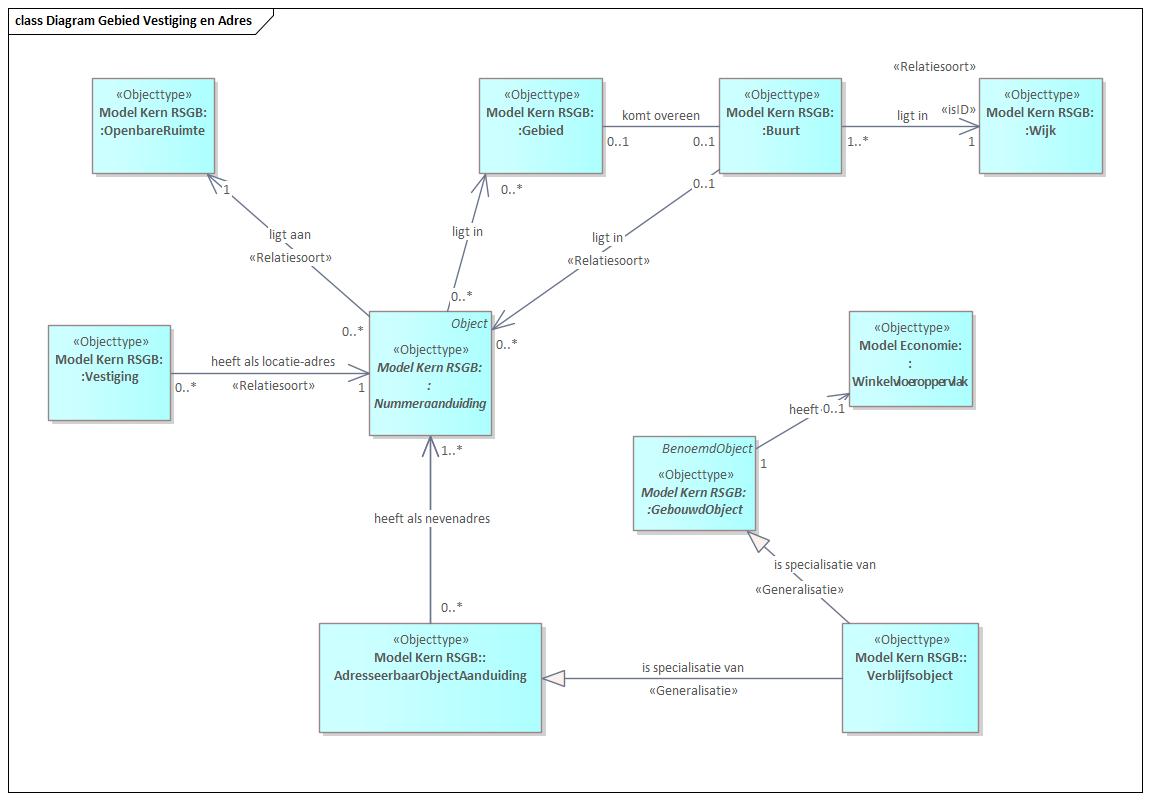
Diagram (in Dutch): Economy and locations — link to BAG.
The address of a Branch is recorded via Addressable Object Designation, linking to the BAG. A specialisation of Addressable Object Designation is Number Designation. Usually a Branch has a Number Designation for its address. Only for Mooring places and similar is this different — too rare to model here.
For a Built Object, the Retail Floor Area is tracked. This information comes from specific research. Vacancy is also tracked. The Built Object records the number of square metres of floor area (information from BAG). This way, retail research data and BAG data can be compared. A Built Object is a specialisation of a Residence Object, to which the Number Designation is linked to record the house number.
Within an Area, multiple Addressable Objects lie. An Area has different kinds, such as retail area and project-development area. Areas may also correspond to a Neighbourhood which together form a District. Area is an extension of the RSGB because there is no clear way to link Neighbourhood (and hence District, Place and Municipality) to Addressable Objects.