HR (Human Resources)
The HR policy domain has the following elaboration.
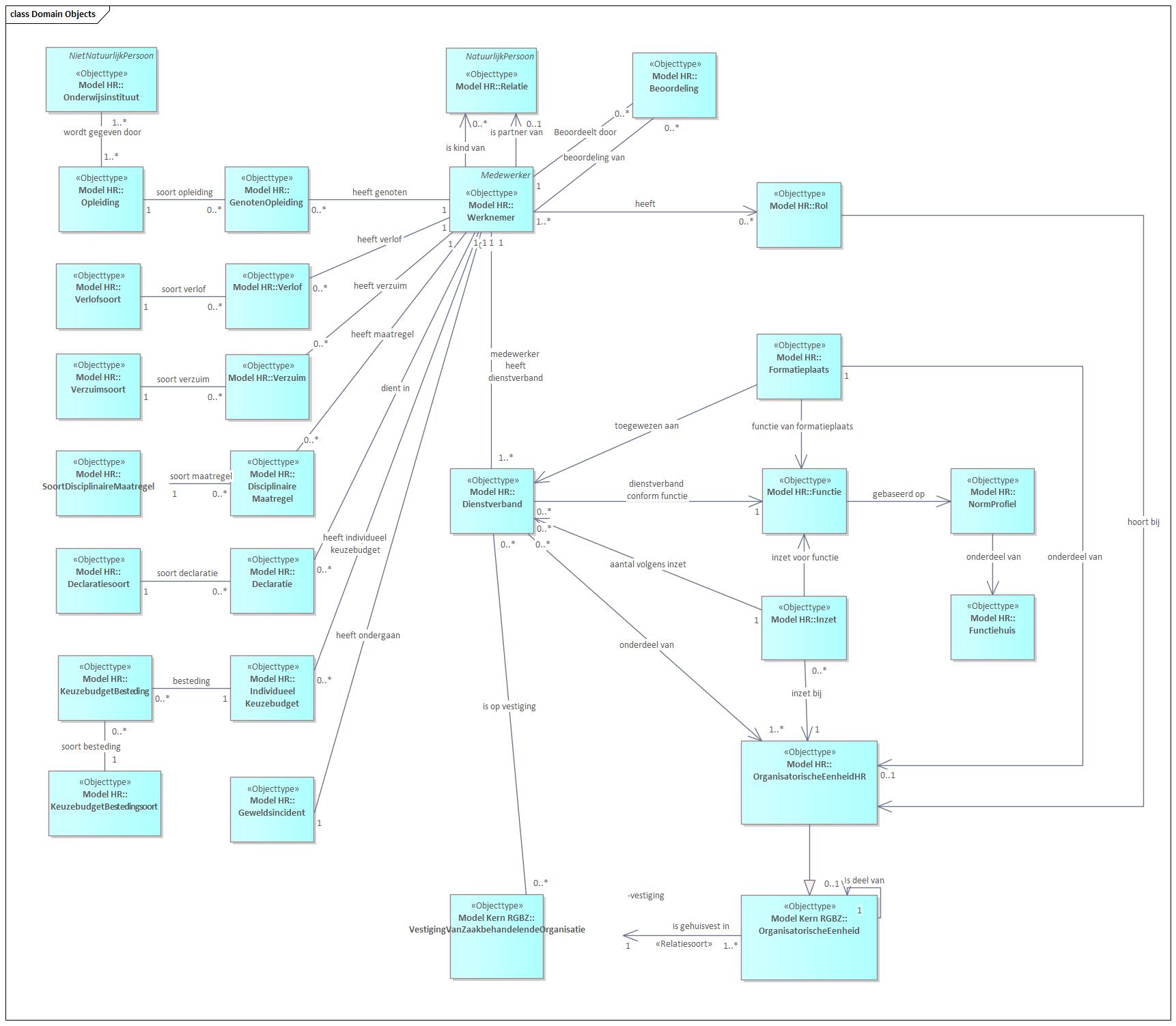
Diagram (in Dutch): the HR data model centred on Employee, Position and Department.
Central is the Employee, who has one or more Appointments, plus Leave, Absence and an Individual Choice Budget. The latter three all have master data defining different kinds, for example: maternity leave, parental leave, special leave and regular leave. An Appointment is for a particular function and belongs to a Department; this may be at multiple locations. A Function belongs to a Function Structure describing the makeup of functions for a given period. An Employee may have multiple appraisals, given by a manager (also an Employee).
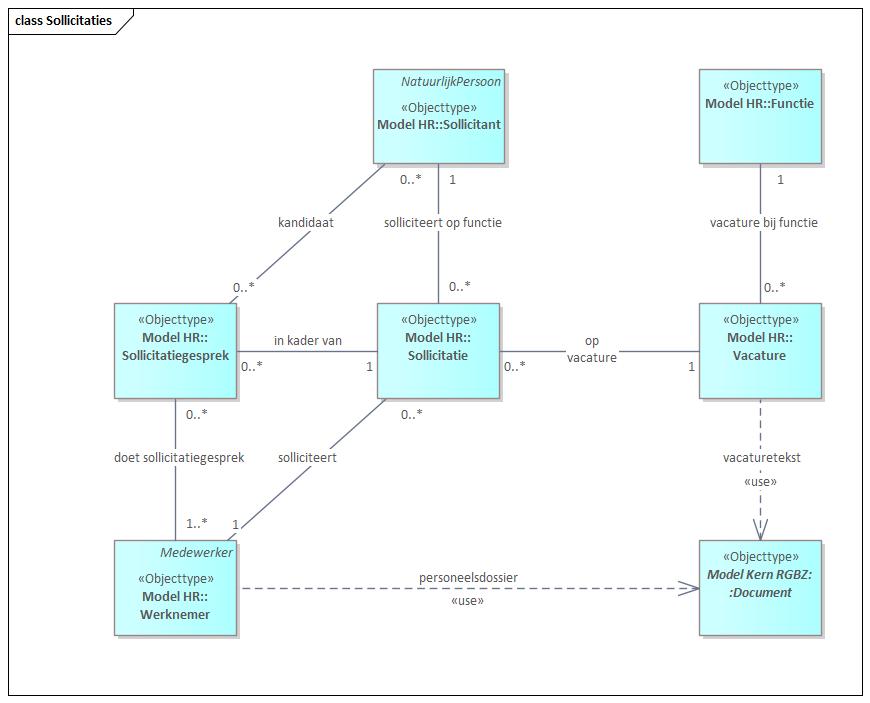
Diagram (in Dutch): the Applications model — applicants, vacancies and interviews.
The figure above describes Application, which is always for a Vacancy. A Vacancy always belongs to one function and may have multiple vacancy texts. Applicants submit Applications and may have multiple interviews involving one or more Employees.
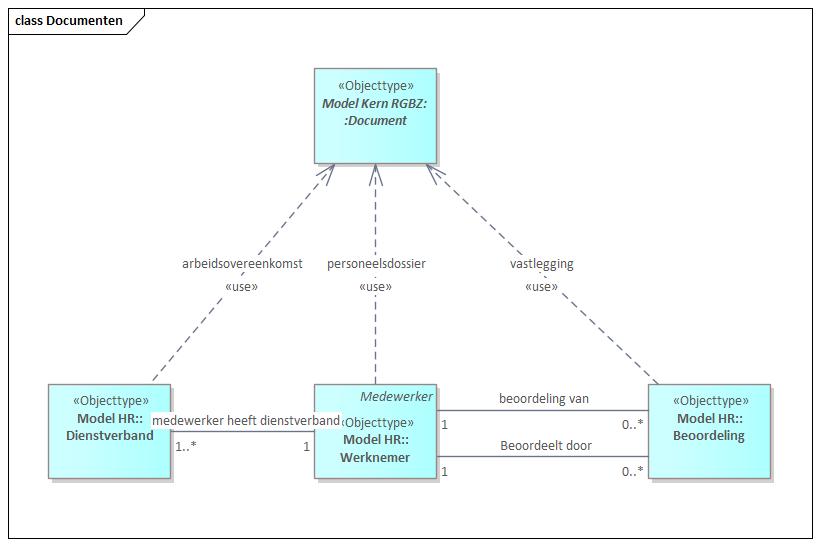
Diagram (in Dutch): document types in HR — Employment Contract, Personnel Document, Vacancy Text.
The HR model does not use DOCUMENT from the RGBZ directly, only derived documents. Different document types can be used: Employment Contract, Personnel Document (containing personnel agreements; can also be used for other communication) and Vacancy Text.
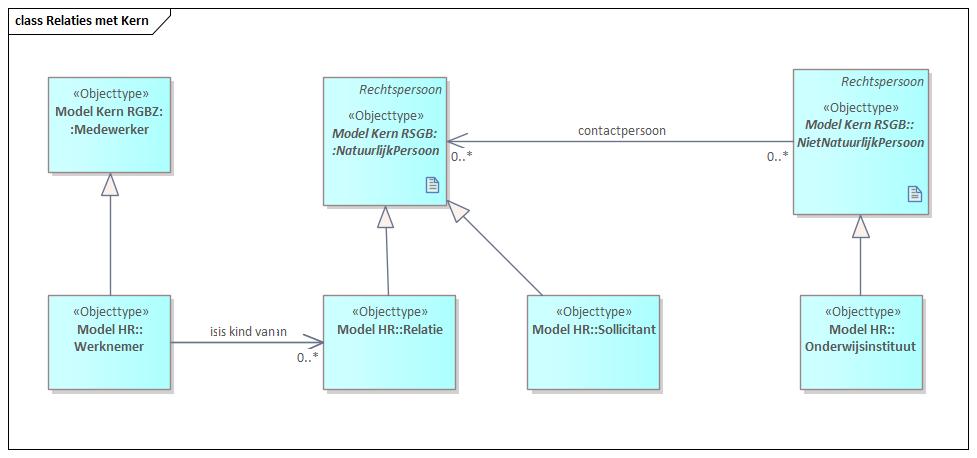
Diagram (in Dutch): how persons (Employee and Relation) are modelled in HR, derived from RSGB types.
The HR model does not use persons as defined in the RSGB directly — only derived entities. The figure shows how the Employee entity and the linked Relation entity are defined.