Council Office
The definitions of the object types are derived from information stored in the RIS (Council Information System). Use was also made of the information model from the Open Council Information pilots, which at the time of writing is still under development. The data as currently administered in Delft's RIS is taken as a starting point, deviating in a few places from the Open Council Information model.
The figure below shows the information model. Central are Council Document and Meeting. Council documents are all documents handled by the council — amendments, motions, proposals, replies, incoming documents and announcements. Council Document derives from the generic RGBZ type DOCUMENT and inherits its attributes. In a Meeting, multiple agenda items are discussed, each of which may handle several council documents. A particular Agenda Item may include a Vote, which concerns a particular Council Document. Vote is taken from Open Council Information but is not currently supported by the RIS. There may be video recordings of entire meetings or of individual agenda items.
Council documents may have 0 or more submitters. Documents with 0 submitters are procedural items such as the agenda and the list of incoming documents. A Submitter may be a Council Member, a Board Member or a generic LEGAL ENTITY. The latter is used when a citizen, business or institution submits a document. Both Council Member and Board Member are derived from RESIDENT in the RSGB.
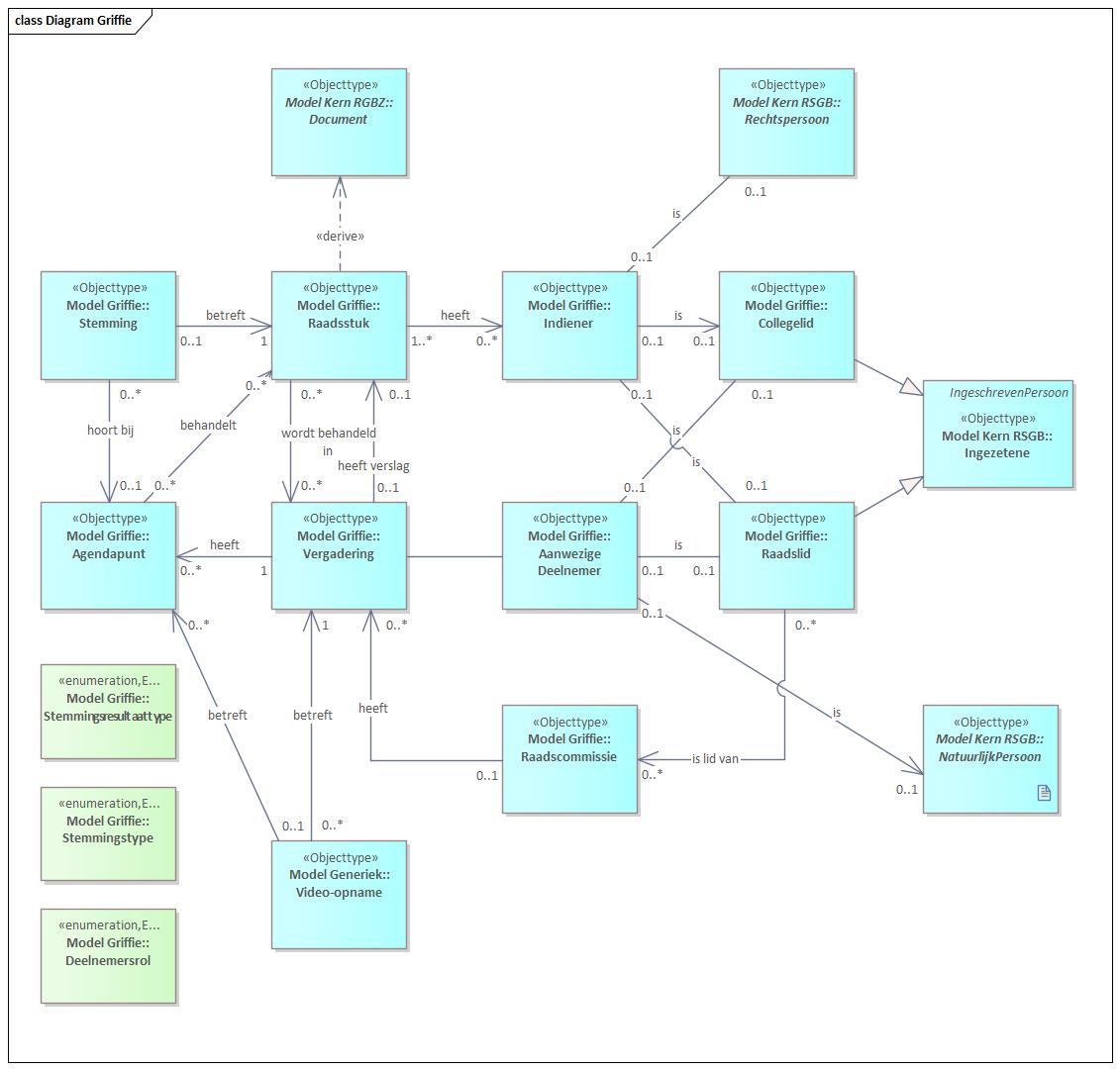
Diagram (in Dutch): data model for Council Office (Griffie), centred on Council Documents and Meetings.
Meetings have multiple Attending Participants. An Attending Participant may be a Board Member, a Council Member or another NATURAL PERSON. NATURAL PERSON is used when a third party (citizen or representative) speaks at a meeting. LEGAL ENTITY is not used here because only natural persons can speak; companies or organisations being represented are recorded in Participant.
Committees may have multiple Council Members as members; committees also have meetings. Council documents have categorisation to improve findability. This is shown in the figure below: council documents may belong to multiple dossiers, may have a Category, may have a Task field, and may belong to multiple Programmes.
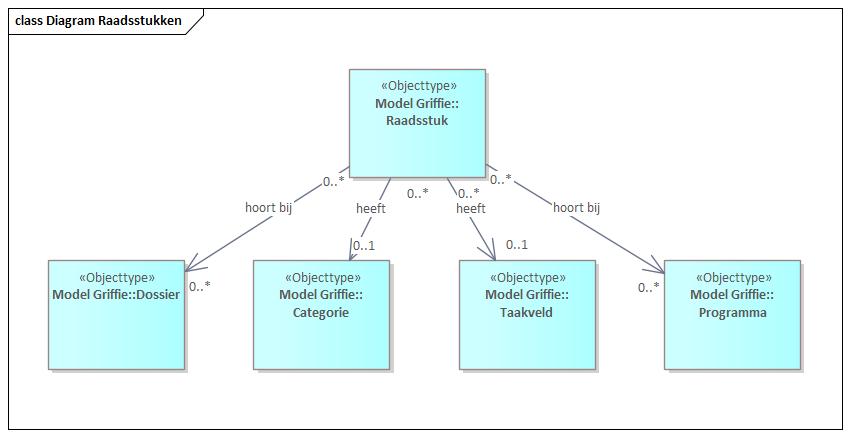
Diagram (in Dutch): data model for Council Documents and their categorisation.