Service Delivery
The data definitions for service delivery revolve around the object type Customer Contact. A Customer Contact is an actual contact between the municipality and a citizen or business. It originates from RGBZ 2.0, which defines:
- Personal contact: an event of a continuous time span in which information is exchanged interactively between at least two parties — at least one a municipal employee and at least one a natural person, possibly in the role of employee of a non-natural person or branch.
- Anonymous customer contact: an event in which information is exchanged interactively between at least two parties — at least one a municipal employee and one or more natural persons who are not identified.
- Information receipt: an event in which information intended for the municipality is received by the municipality (even if the sender is known, the sender is not actively involved).
- Information dispatch: an event in which information intended for a citizen or business is sent by the municipality (even if the addressee is known, the addressee is not actively involved).
In the GGM, Customer Contact is filled in more concretely so it can support service-delivery statistics — wait times, hung-up calls, occupancy. Customer contacts can originate from:
- A Phone call — when a citizen, business or other party calls the municipality. If a conversation results, there is a Customer Contact; if the caller hangs up beforehand, there is a phone call but no customer contact.
- A Counter Appointment — when a citizen, business or other party has an appointment, this becomes a Customer Contact if the appointment actually takes place. Otherwise the counter appointment is still tracked.
- An Application or Report — a message sent by a citizen, business or other party to the municipality, via an electronic form or otherwise. When received, there is always a Customer Contact. This object type can also be used for outbound communication.
The next figure shows Customer Contact in relation to Phone calls and Counter Appointments.
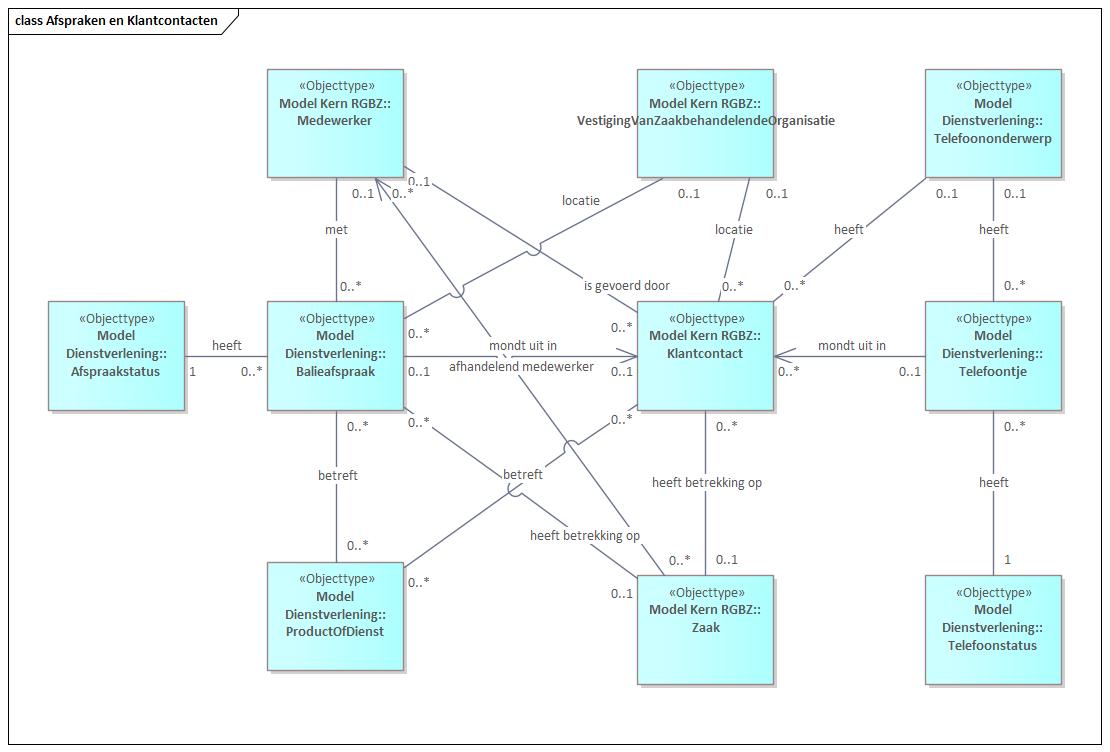
Diagram (in Dutch): Customer Contact in relation to Phone Calls and Counter Appointments.
A Customer Contact may relate to a Case, may take place at a particular Office of the municipality (empty for electronic contact), and may concern multiple Product or Service.
A Phone call has a Phone Status such as: hung up early, picked up, etc. A Phone call may have a Phone Subject. If a Phone call is transferred, multiple Customer Contacts may result.
A Counter Appointment is with a Staff Member and may concern multiple Product or Service. An Appointment Status takes values like: Waiting, In progress, No-show, depending on the front-desk system. Several wait-time concepts apply:
- Gross wait time — the time someone actually waits after checking in, regardless of the appointment time.
- Net wait time — the time someone is helped earlier or later than agreed. Earlier yields negative net wait time; later yields positive.
The next figure shows the elaboration for an Application or Report. An Application or Report is a message a citizen, business or other party sends to the municipality. It may be a (scanned) letter, a message via the report system or website, or messages from external apps such as Buitenbeter.
Application or Report is modelled flexibly: it is submitted with a form of a particular Form Type, on which a number of fields are defined as Form Type Field. The GGM thus supports arbitrary forms, regardless of the fields on them. Linked to Form Type Field and to Application or Report is Application Data containing the actual contents. An Application or Report has one or more Subjects, themselves hierarchically organised.
At the Municipality of Delft we use Pivot queries to translate applications and reports into specific forms.
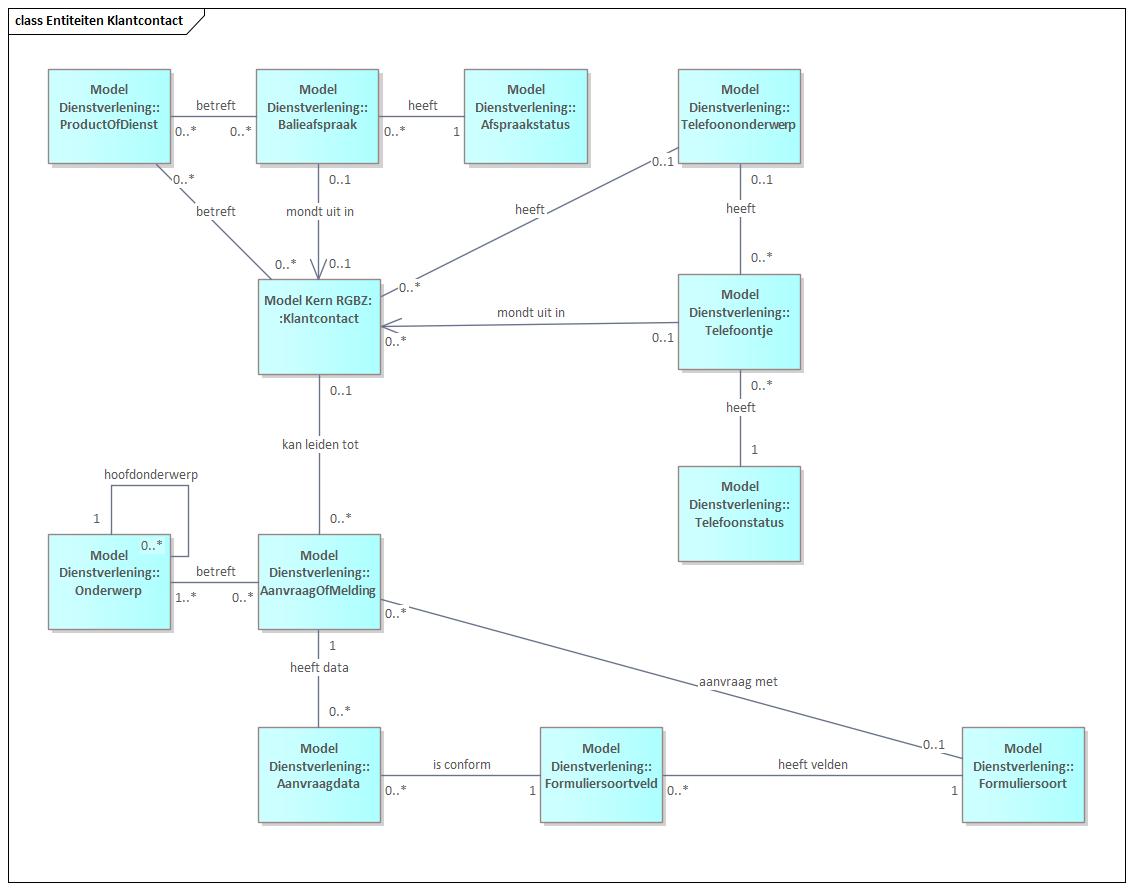
Diagram (in Dutch): object types for Applications and Reports.
The next figure shows the link between Customer Contact and Case from the RGBZ. A Customer Contact may relate to a Case; an Application or Report may lead to a Case.
Compared to the RGBZ, the model is extended with Payment and Levy — the municipality imposes a Levy on many products and services, on which a Payment must be made.
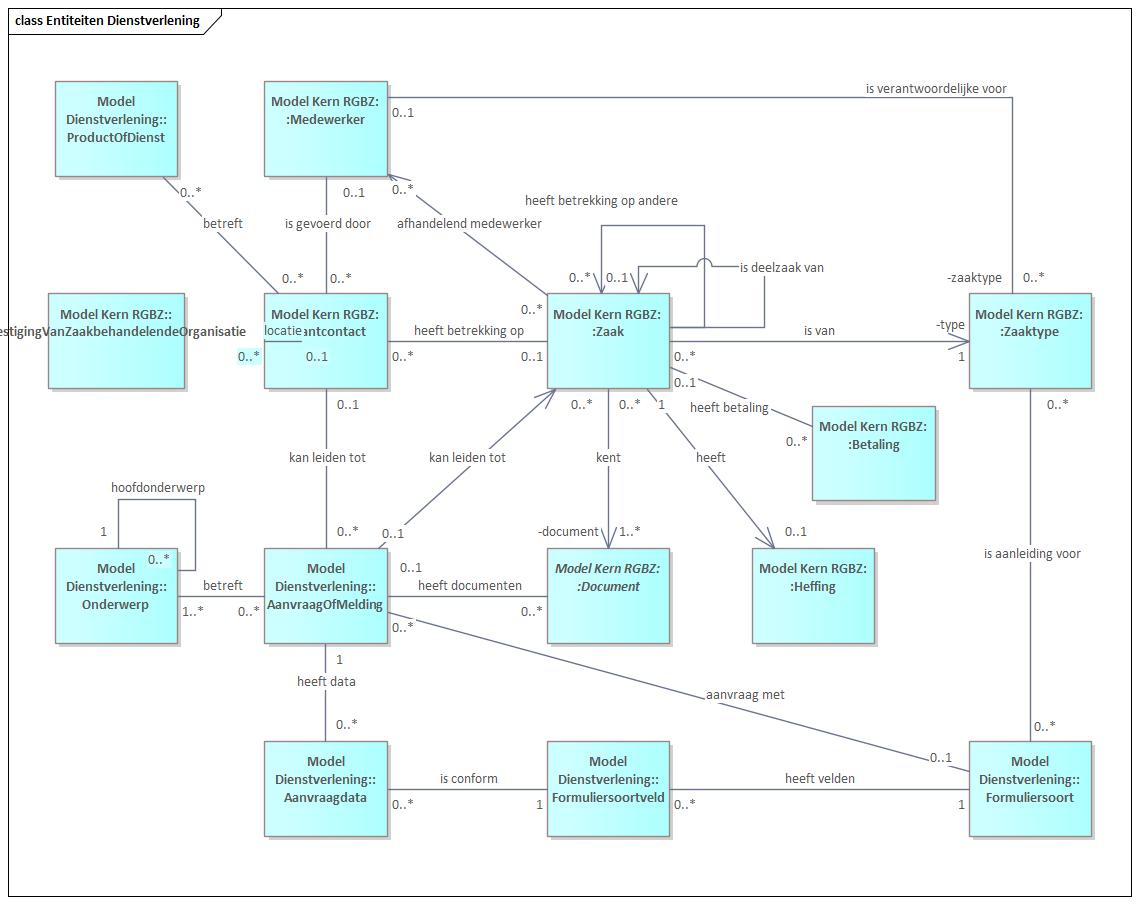
Diagram (in Dutch): the link between Customer Contact and Case (RGBZ).
The next figure shows the relationship of Stakeholder to Customer Contact and Case.
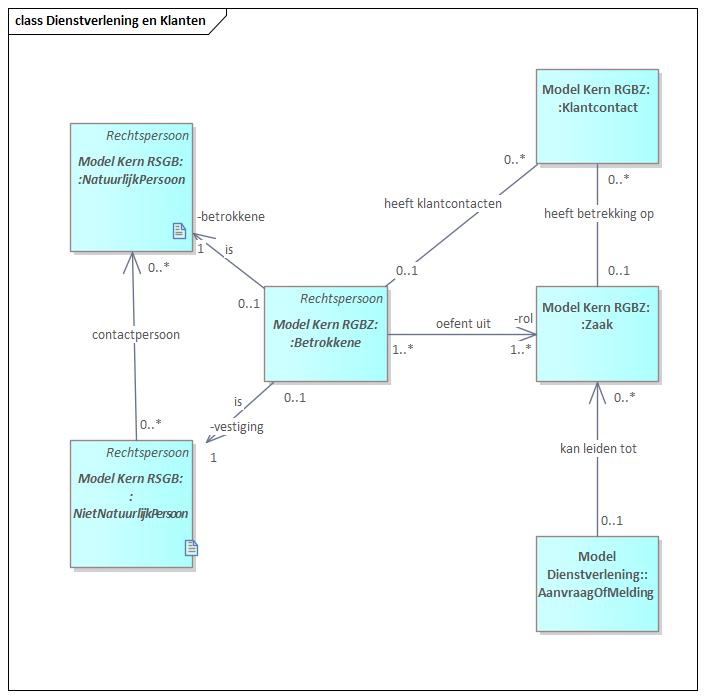
Diagram (in Dutch): Stakeholder in relation to Customer Contact and Case.